1997-2002 Academy of Fine Arts Vienna, Austria; Field of study: Painting & Graphic Art, Public Art, Prof. Hubert Schmalix
2002 University graduation with distinction (Magister)
1989-1997 Art lyceum in Braşov
lives and works in Lower Austria
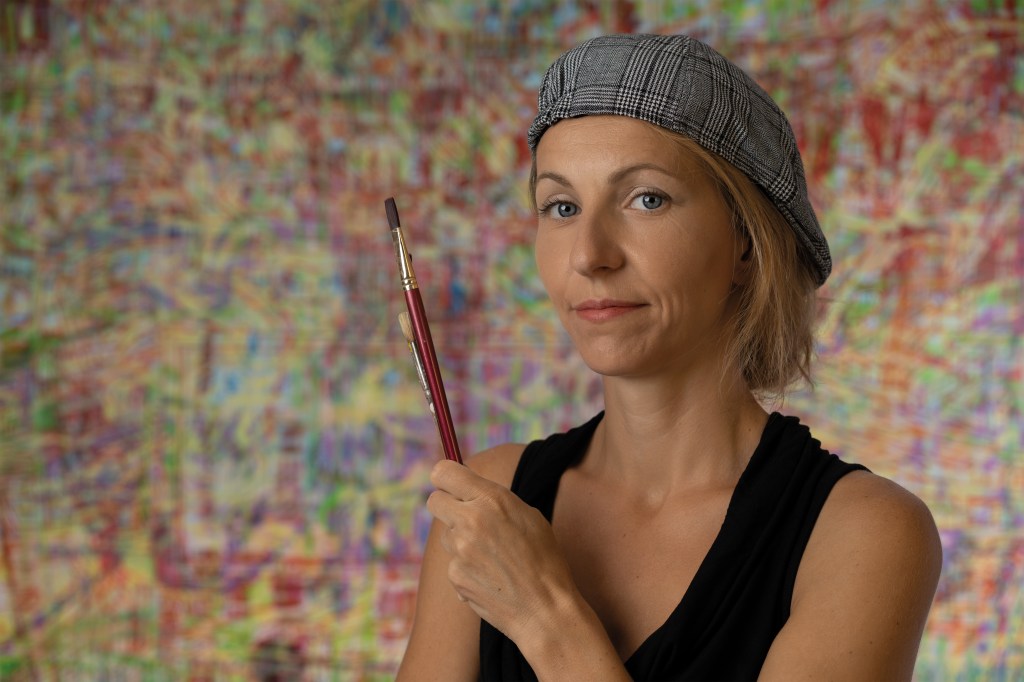
Looking at the pictures by Loretta Stats creates the feeling that she has been ardently working on advancing a certain concept and that she tries to get a grip on an increasingly complex thought system through the means of painting, but without compromising on her personal style. A style that was discovered, that clearly communicated that it was somehow good, but also that something had to and should still happen to it.
Stats is strongly committed to a youth culture, both because of her age and her socialization; she conveys the medium of painting by the medium of photography, which reflects a current trend among young painters. Irrespective of whether her objects are figuratively or conceptually superimposed or she, as in rare cases, simply devotes herself to abstraction – nearly always a photograph or another electronically created image layer plays a prominent role as information carrier. Just like the flood of images from everyday media, advertising and television stands between ourselves and reality, Stats puts camera images, photographs or computer images between everyday life as we experience it and her painting. It is one of the artist’s basic statements that today all of us – and there is no escape – experience the world as it is conveyed to us. That we are only able to articulate our perception of the world, of life, via representatives of reality. She has also drawn on the realm of dreams, the sphere of the unconscious, which is terribly crafty and at the same time almost deliberately and elusively perfidious. The pictures’ approach is based on a partly object-like, partly abstract calculus, which alienates and displaces their content in a way that transfers us to virtual spheres of experience – where familiar perspectives are not valid anymore, where you are almost forced to accept their new guise as heteronomously determined. Of course, this calculus, this control is also communicated by the style of painting, because even though there is a lot to see in the pictures, the painting itself and the lines drawn with brushes are characterized by a distinct accuracy. There are very clear boundaries between individual color fields, and the exceptionally complicated architecture of the pictures presents an aesthetic effect thoroughly considered. Many things are merely suggested, disintegrated; color arrangements intensify to form solid spaces in which the protagonists meander like phantasms, like fragments. It is obvious that the reasonable world starts crumbling in her pictures, but not by means of the unconscious, of automatisms, of spontaneous, uncontrolled action and the weakness of the ego associated therewith – no. It is strength. In her pictures, she develops a multilayered system of devised illusions and unrealities and replaces the authentic image with a meta-reality, cut into pieces and reassembled in an alien way.
Viewing the pictures raises the feeling that Stats is taking more and more liberty to act as inventor of her own world. The pictures tilt into an independent, autonomous pictorial reality.
Subjects are superimposed with a matrix readable with relative clarity, with a painted grate that, just like the representations below – which are drawn from her pool of photographs and snapshots – refer to the artificiality, to the factitiousness of a world with virtual character. An artificially generated system is refuted. Below this matrix, the manifestness, the everyday scenes loose substance and reality. With this matrix, she brings the statement to a, rather solitary, head that she merely mediates – externally mediates – our everyday world. Still, her pictures are an objection, for she uses painting and its possibilities to individually modify and vary a given scene.
She simply takes the omnipresent, externally determined life as her subject and has the faculty to rehash it in a very exciting way. With a blithe and varied colorfulness, with an incessant play of forms and brushstrokes, and with an incredible number of feints, the pictures of Loretta Stats simply whet your appetite to see more.
by Ingried Brugger, Director BA Kunstforum, Vienna
Dream motifs are visualized in small-format pictures, in a collage-like, fragmentary sequence of separate, freely fluctuating associations. As we know, the subjective experience of a person dreaming is detached from the conscious perception of time and space. The visual cosmos of dream visions is rather tied to the individual experience of the sensations of desire, pain and all other sensory perceptions, fantasies, obsessions and memories.
In a structure made of superpositions, these works show a plurality of narrative, interactive dream sequences, encoded in a multilayered picture language of transparent, diaphane space fragments.
The visual wealth of the picture series, which seems to be swinging with the individual rhythm of the unconscious, is also manifested in the different modalities used, ranging from simple drawings to combinations of pictures and writing, the supremacy of certain color hues and a haptic breakdown of the image plane by the application of latex and textile elements. The incoherence and illogic of dreams is reflected in a vicissitudinous facture: a melodic flow of lines over gestural color blobs, graphic precision becoming blurred in a color fog. The clashing of different visual levels is embodied by variations of style and color accents. For each dream experience, the picture language seems to be encoded anew, with a new pitch and individual references. Fragments of urban space, body parts, figures and toys appear in focus, like symbols within an individual scale of significance.
The specifically female connotation of the works is by nature not only evidenced by their (narrative) subjects, but also by a conscious excursus to the ornamental. The flood of media images in everyday life is contrasted with a subjective cosmos of images from one’s own dream experiences, and thus, a virtual sphere is built for self-questioning and obsessively delving into one’s own ego.
Dr. Cornelia Cabuk
©Loretta Stats
how to scream, 2024
Participatory presentation of several works of a series of paintings
The painting series how to scream examines questions of human identity in the
context of the continuous, overwhelming flood of images that surround us.
Globalization is making it increasingly difficult to define geographical positioning with its associated characteristics and is therefore disrupting familiar ways of thinking and seeing things, or long-established traditions. On the one hand, these circumstances enable a liberalization of definitions and existing parameters, but at the same time they raise countless questions regarding their possibilities for further development.
This dichotomy between new and old, public and private, joy and fear is the point at which the works in this series start. The motifs originate from teenagers’ selfies – everyday snapshots of moments with sometimes more and sometimes less meaningful activities or emotive meanings, generated via different social media channels. A nowadays routine activity of the emerging generation, which completely inverts the way we deal with visualization processes and thus advances the confrontation with historical representations to new levels.
At the interface between persiflage and documentation, the installation presentation creates a communicative situation between the depicted figures and the viewers. The disproportionately enlarged eyes and the silhouettes turned towards the camera cause interaction and confrontation in equal measure and thus confer the works a certain power in space, which as a result grants the painted figures the right to play an important role under the protection of their changed external features, in order to enable the achievement of the originally intended goal of public presence.
As part of the public presentation, visitors are asked to photograph themselves with the works and to make the resulting photos available to the artist, to become her new muses in order to create site-specific and at the same time internationalized image combinations and connotations and thus provide a support for the continuation of further dissemination of cultural interaction.

